10 Questions to Ask Your Rolex Sales Associate
Master the art of buying a luxury timepiece. Here are the 10 essential questions to ask your Rolex Authorized Dealer to build rapport and secure the watch you want.

The most effective questions to ask your Rolex sales associate focus on demonstrating your genuine passion for horology rather than just your budget. Start by asking about the specific history and technical lineage of the reference you are interested in to establish credibility. Follow this by inquiring about the store’s specific allocation process—how they prioritize clients and what “registering interest” truly means in their boutique. You should also ask about the practical differences in case materials, the recommended service intervals for that specific calibre, and whether they participate in the Rolex Certified Pre-Owned program. Finally, ask what they are wearing or personally admire; building a human connection is the single most important factor in moving from a “prospect” to a “client.”
The Psychology of the Authorized Dealer
Walking into a Rolex Authorized Dealer (AD) these days can feel less like shopping and more like an audition. The display cases might be empty, boasting only “Exhibition Only” placards, but don’t let that intimidate you. The inventory exists; it’s just in the safe, waiting for the right wrist.
Your goal isn’t just to ask questions—it’s to signal that you are a collector, not a flipper. Sales associates are trained to sniff out speculators who want to buy a GMT-Master II just to resell it for a profit the next morning. By asking the right questions, you shift the dynamic. You become an enthusiast.
Here is the strategic roadmap to navigating that conversation.
1. “Can you walk me through the specific history of this reference?”
Start here. Even if you already know the answer.
Why? Because it gives the associate a chance to flex their knowledge and shows you value the heritage, not just the hype. If you are looking at a Submariner, ask about its evolution from the 1953 original. If you are eyeing a Daytona, ask about the transition from Zenith movements to the in-house calibre 4130 and 4131.
This opens the door to deeper conversations about specific categories. For instance, if you are discussing aviation heritage, you might pivot the conversation to compare the GMT-Master II against other heavy hitters in the category. We’ve broken down the nuance of these choices in our guide to top 5 pilot watches, which can help you sound even more informed during this chat.
2. “How does your store handle ‘Expressions of Interest’?”
Let’s address the elephant in the room: The List.
Most associates hate the term “Waitlist” because it implies a first-come, first-served queue. That rarely exists. Instead, ask about their process for “allocating pieces to clients.”
Does this specific boutique prioritize locals? Do they prefer clients who build a “profile” with jewelry purchases? This question is crucial because it forces a moment of honesty. If they tell you, “We prioritize clients with a purchase history,” you know exactly where you stand. You aren’t fighting a queue; you’re building a relationship.
3. “What are the wearability differences between these case materials?”
Rolex is famous for its Oystersteel (904L steel), but their catalog is diversifying. You might be torn between the heft of white gold, the durability of steel, or the lightweight nature of the new RLX Titanium introduced in the Yacht-Master 42 and Deepsea Challenge.
Asking this shows you are thinking about wearing the watch daily, not keeping it in a safe.
If you are looking at a larger sports model, the weight difference is massive. A steel Sea-Dweller feels like an anchor compared to the featherlight touch of titanium. Understanding the metallurgical nuances is key to long-term comfort. For a deep dive before you visit the store, read our analysis on titanium vs stainless steel so you can debate the pros and cons of scratch resistance versus weight with your associate.
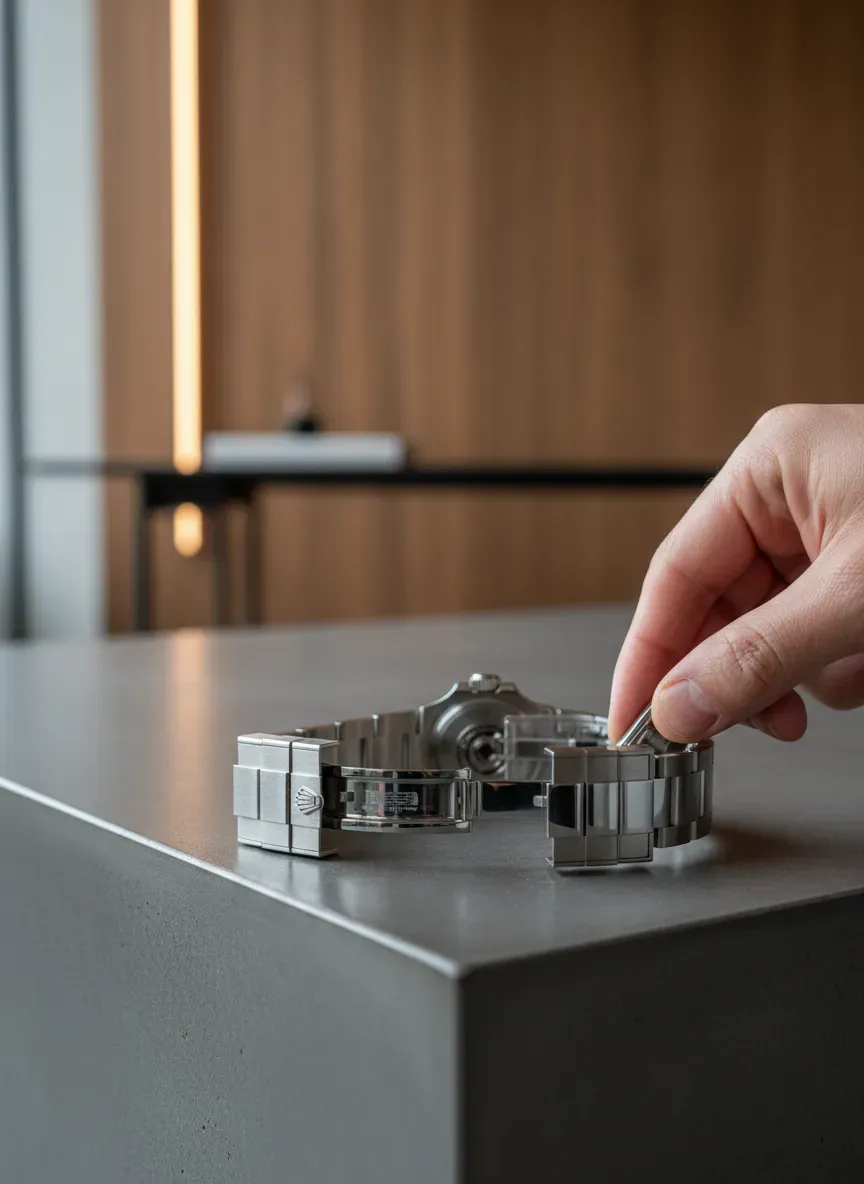
4. “Can you explain the movement architecture and power reserve?”
You don’t need to be a watchmaker, but asking about the engine under the hood separates the casual buyer from the aficionado.
Ask about the difference between the 3235 movement and its predecessor. Ask about the Chronergy escapement. Ask what the 70-hour power reserve means for your weekend rotation (hint: you can take it off Friday and it’s still running Monday morning).
If you are looking at something more complex, like a Sky-Dweller, ask them to demonstrate the Ring Command bezel. If it’s a GMT, ask how to set the “jumping hour” hand.
This is also the perfect time to discuss how different functions impact the watch. Many buyers are confused by the intricacies of dual time zones or annual calendars. If you want to impress them with your knowledge of mechanics, brush up on how these work by reading our breakdown of complications explained: GMT & moonphase.
5. “What represents the best entry point for my collection?”
If this is your first Rolex, be humble. Asking for a Daytona Le Mans as your first purchase is a guaranteed way to be politely ignored.
Ask the associate what they recommend for a first major acquisition. They might steer you toward an Oyster Perpetual or a Datejust. Listen to them. These models are the backbone of the brand for a reason.
Sometimes, the best entry point isn’t brand new. With the launch of the Rolex Certified Pre-Owned (CPO) program, many ADs now have vintage or recent trade-ins available immediately. This is a massive shift in the market. You might walk in wanting a new Submariner and walk out with a neo-vintage model that has more character.
If you are open to the secondary market, specifically regarding underrated models, checking out availability for a pre-owned Rolex Air-King can be a smart move. It’s a conversation starter that shows you appreciate the quirky side of Rolex history.
6. “How often should I actually service this model?”
Rolex officially recommends service every 10 years, but real-world usage varies. Asking this shows you care about the longevity of the asset.
It also leads to a discussion about care. A watch that isn’t worn often allows the oils to coagulate. If you plan on having a rotation, you need to keep the movement active. This is where a high-quality winder comes into play.
If you want to keep your automatic watches running perfectly when they aren’t on your wrist, I highly recommend investing in a WOLF Heritage Single Watch Winder. It’s silent, reliable, and prevents you from having to reset your complications every time you switch watches.
7. “Do you have any exhibition models I can try on?”
Never buy a watch based on pictures alone.
A 40mm case on paper acts differently depending on the lug-to-lug distance and the case thickness. The “Super Case” Submariners wear square and large, while the new 12-series Submariners, despite being 41mm, actually wear more elegantly due to tapered lugs.
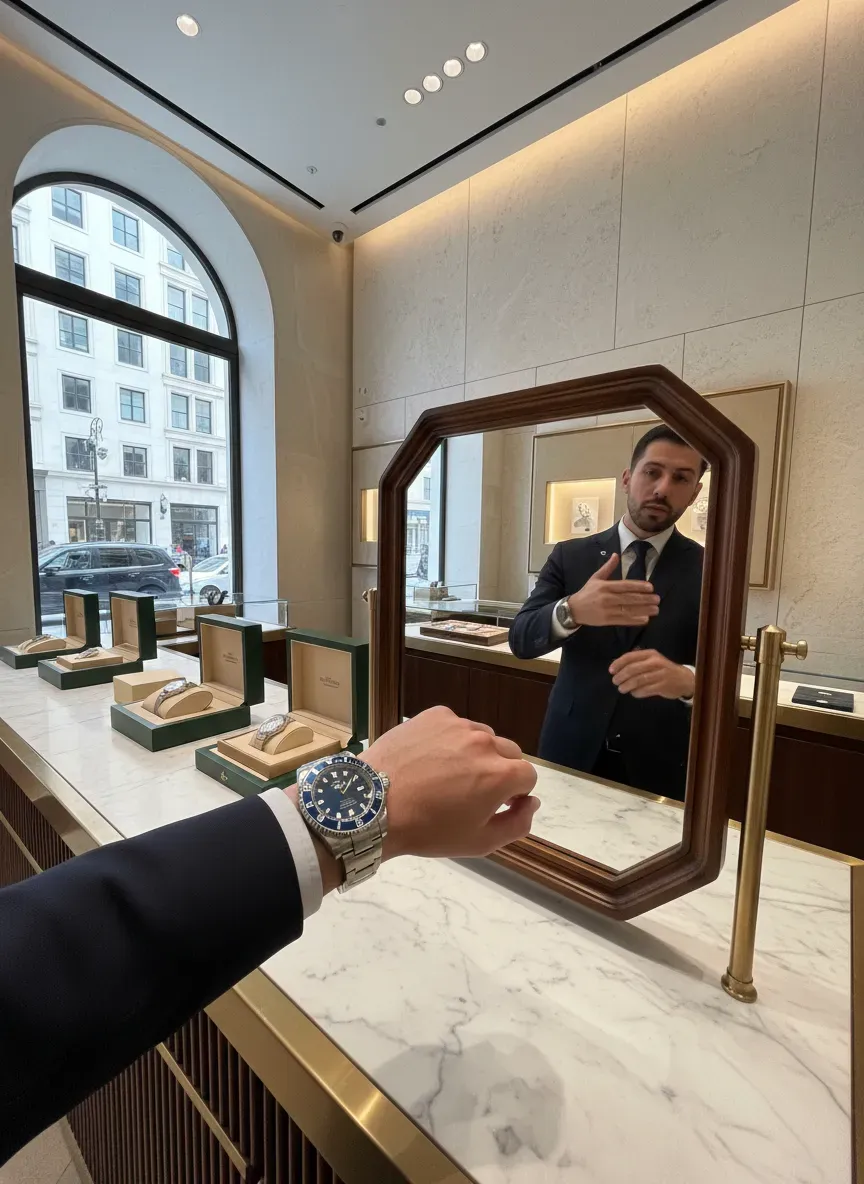
Ask to try them on. Even if you can’t buy it today, knowing how a GMT-Master II sits on your wrist versus a Yacht-Master is vital data. Take photos. Check the clasp. See if the Glidelock extension system fits your lifestyle.
8. “How should I insure and transport this timepiece?”
This is a practical question that signals you are ready to transact.
Ask if they provide an appraisal for insurance purposes (most do). Ask about the warranty card activation. But also ask about travel. Rolex watches are built like tanks, but they are scratch magnets when tossed loosely into a gym bag.
You need a dedicated spot for your watch when you’re traveling or hitting the gym. A solid, crush-proof case is non-negotiable for protecting your investment. I personally use a CASEBUDi Watch Travel Case for its rugged simplicity and protection.
9. “What watch are you wearing today?”
Turn the tables.
Sales associates are enthusiasts too. They stare at these watches 40 hours a week. Asking about their wrist check breaks down the “buyer/seller” wall and makes it a conversation between two watch lovers.
Maybe they are wearing a beat-up Explorer I from the 90s. Maybe it’s a Tudor Black Bay. Whatever it is, compliment it. Ask why they chose it. This builds the rapport necessary to get the call when the new inventory arrives.
10. “What is the best way to maintain the finish at home?”
Finally, ask about hygiene. It sounds trivial, but a dirty watch is a sign of a careless owner.
Rolex steel is resilient, but the links accumulate grime, DNA, and lotion, which can cause “bracelet stretch” over decades as the grit acts like sandpaper between the pins.
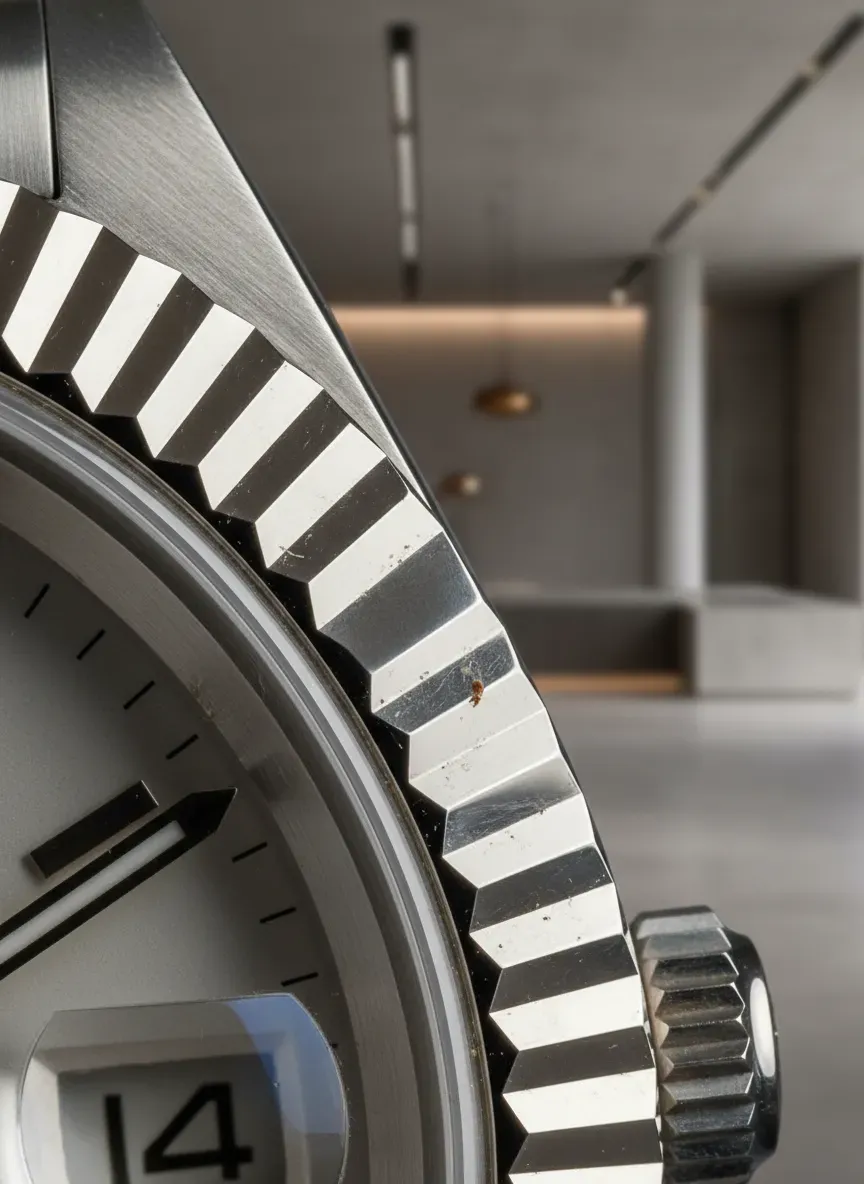
Ask them their preferred method for cleaning. They will likely tell you warm water and a soft brush. It demonstrates that you intend to baby this thing. For the best results at home, get yourself a proper Professional Ultrasonic Jewelry Cleaner or a simple microfiber kit to keep that platinum bezel sparkling.
The Follow-Up
Once you’ve asked these questions, don’t just disappear.
If you had a great conversation, get the associate’s card. Send a thank-you email a few days later, referencing a specific part of your chat (“I’m still thinking about what you said regarding the Sky-Dweller’s movement…”).
Buying a Rolex at retail price is a marathon, not a sprint. The questions above are your running shoes. Lace them up, be patient, and enjoy the chase.