Omega vs. Rolex: Why the Speedmaster is the Technical King
Omega vs Rolex head-to-head: Why METAS certification, Co-Axial escapement, and NASA flight heritage make the Speedmaster technically superior to the Rolex Submariner and Daytona in 2026.

Feb 22, 2026 - Written by: Brahim amzil
Omega vs. Rolex: Why METAS Certification and NASA Heritage Make the Speedmaster the Technical King
The Omega Speedmaster currently holds the title of the technical king over Rolex due to its Master Chronometer (METAS) certification, which guarantees precision of 0/+5 seconds per day alongside magnetic resistance up to 15,000 gauss—a standard Rolex’s Superlative Chronometer does not explicitly match in magnetic shielding. Combined with the Co-Axial escapement that reduces mechanical friction and a lineage of flight-qualification by NASA for all manned space missions, the modern Speedmaster offers superior horological engineering and provenance at a price point where it is actually attainable at retail.
The battle between Omega and Rolex is the horological equivalent of Ford vs. Ferrari, or perhaps more accurately, Apple vs. Android. One is a master of marketing, incremental evolution, and impenetrable brand equity. The other is a powerhouse of technical innovation, transparency, and distinct historical utility.
For years, the conversation has been dominated by resale value. “Buy the Rolex,” they say. “It’s money in the bank.” But if we strip away the gray market hype, the waitlists, and the investment bros, and look strictly at the watchmaking—the gears, the springs, the physics, and the history—the narrative shifts.
Right now, logically and technically, the Omega Speedmaster Professional Moonwatch (specifically the caliber 3861) is a superior mechanical device to its Rolex counterparts. Here is why the crown is slipping, even if the market hasn’t admitted it yet.
The METAS Mic Drop: Why Certification Matters
Rolex is famous for its “Superlative Chronometer” standard. It is impressive. They test their movements to -2/+2 seconds per day accuracy after casing. That is tighter than the industry standard COSC (Contrôle Officiel Suisse des Chronomètres).
But Omega looked at that standard and decided it wasn’t enough. They partnered with the Swiss Federal Institute of Metrology (METAS) to create a testing regimen that borders on the sadistic.
Unlike COSC, which tests only the uncased movement, METAS tests the fully assembled watch. And unlike Rolex’s internal testing, which is trusted based on the brand’s reputation, METAS is an independent, government-sanctioned certification with fully transparent results. You can actually type your specific watch’s serial number into Omega’s website and see exactly how your watch performed during the tests.
The 15,000 Gauss Difference
We live in a magnetic world. Your laptop, the clasp on your handbag, your induction cooktop, and the speakers in your car are all emitting magnetic fields. Magnetism is the silent killer of mechanical watch accuracy. A magnetized hairspring sticks together, causing the watch to run frantically fast.
Rolex deals with this using the Parachrom hairspring, which is paramagnetic. It’s good. It works for most daily encounters.
Omega, however, went nuclear. The Master Chronometer movements, like the Calibre 3861 found in the new Omega Speedmaster Professional, are resistant to magnetic fields up to 15,000 gauss. To put that in perspective, an MRI machine operates around that level. You could strap a Speedmaster to a speaker magnet, and it wouldn’t skip a beat.
This isn’t just shielding (like the soft iron cage in the old Rolex Milgauss); the movement itself is constructed from non-ferrous materials like silicon hairsprings. It is a fundamental engineering solution to a modern problem, whereas Rolex is largely relying on legacy materials.
The Co-Axial Revolution
If you want to understand why the Speedmaster is technically superior, you have to talk about friction.
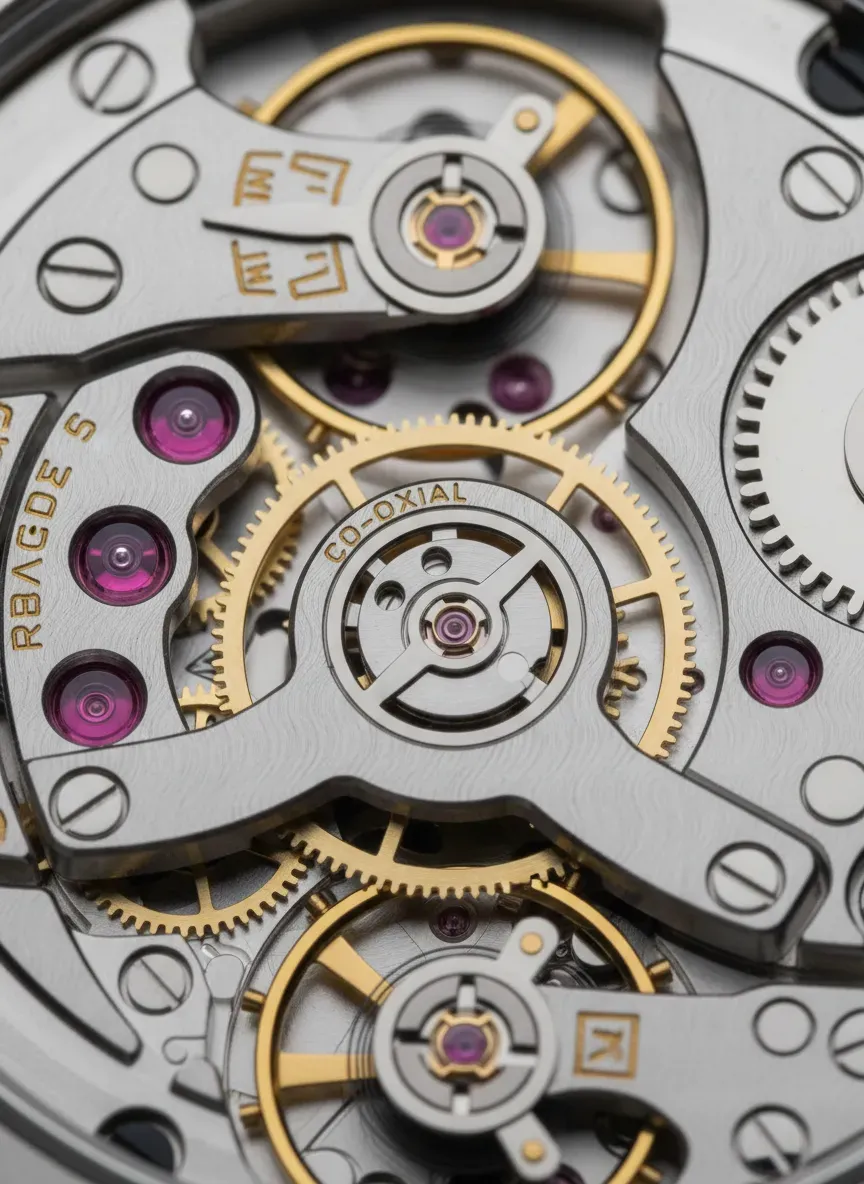
For over 250 years, almost every mechanical watch, including every modern Rolex, has utilized the “Swiss Lever Escapement.” It relies on a pallet fork sliding against the escape wheel teeth. Sliding creates friction. Friction requires lubrication. Lubrication eventually dries out, affecting accuracy and requiring service.
Enter George Daniels, arguably the greatest watchmaker of the 20th century. He invented the Co-Axial Escapement. This mechanism uses radial impulses rather than sliding friction. It pushes the wheel rather than dragging across it.
Omega bought the patent and spent years industrializing it. The result is a movement that maintains its accuracy for longer periods between service intervals because the mechanical wear is drastically reduced.
While Rolex movements like the 3285 found in the Rolex GMT-Master II are workhorses known for reliability, they are essentially optimizing an 18th-century design. Omega is using 21st-century geometry.
Provenance: NASA vs. Marketing
Rolex has an incredible history. They have been to the bottom of the Mariana Trench. They were on the wrist of Mercedes Gleitze swimming the English Channel.
But they have never been flight-qualified by NASA for all manned space missions.
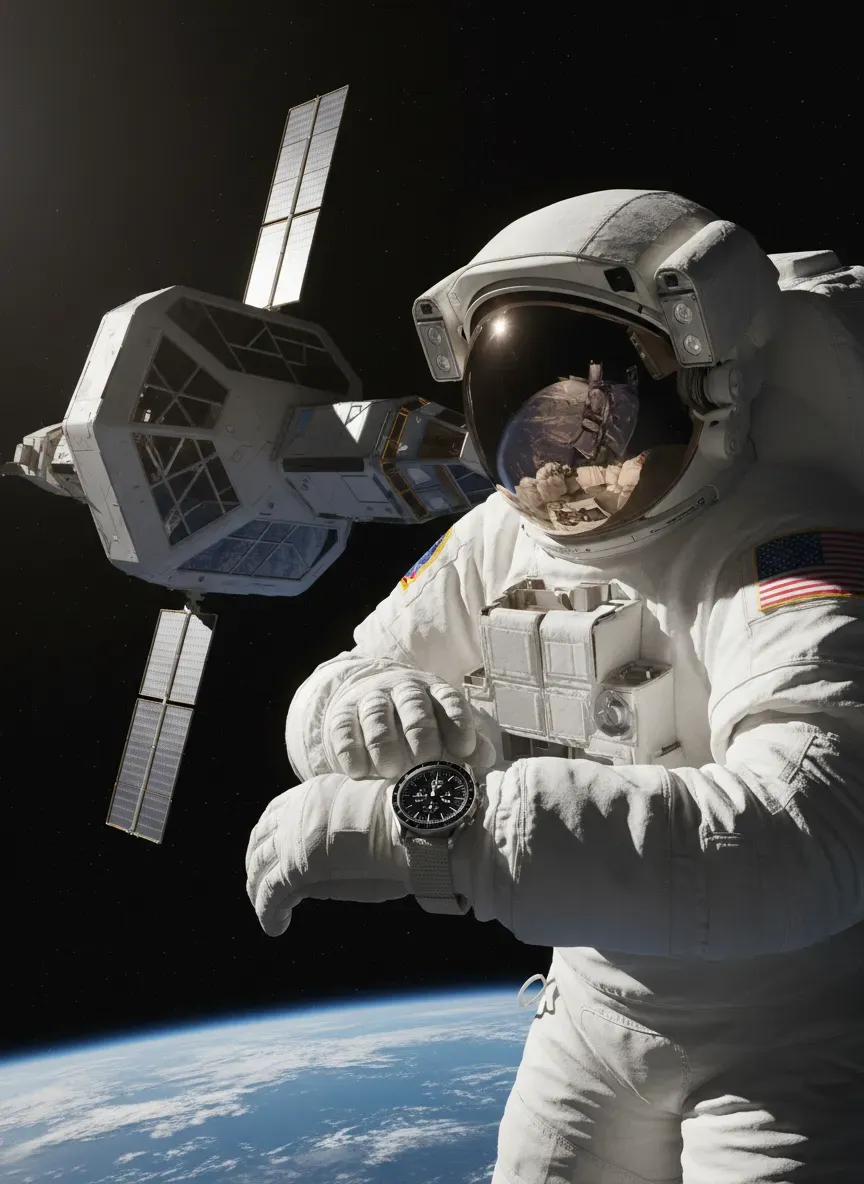
The story of the Speedmaster is not just marketing fluff; it is a matter of survival. In the 1960s, NASA engineers went out and bought chronographs from Rolex, Longines, Hamilton, and Omega. They subjected them to tests that were designed to destroy them:
- Temperatures oscillating between 200°F and 0°F.
- Violent shocks of 40 Gs.
- High and low pressure.
- Pure oxygen environments.
The Rolex Daytona failed. The hands warped; the movement stopped. The Omega Speedmaster survived.
The Snoopy Award
The technical capability of the Speedmaster literally saved lives. During the Apollo 13 crisis, the astronauts’ on-board computers were shut down to conserve power. They needed to perform a critical mid-course correction burn to re-enter Earth’s atmosphere safely.
Jack Swigert used his mechanical Speedmaster to time the burn. It had to be exactly 14 seconds. If it was less, they would bounce off the atmosphere. If it was more, they would burn up.
He nailed it. The crew survived. NASA awarded Omega the “Silver Snoopy Award,” the highest distinction given by NASA astronauts to third parties for contributions to flight safety.
You can buy a watch that looks cool at a dinner party, or you can buy the watch that helped bring Lovell, Swigert, and Haise home.
The Availability Paradox
This brings us to a “feature” that isn’t mechanical, but practical. The best watch in the world is useless if you cannot buy it.
If you decide today that you want a Rolex Submariner, you are in for a humbling experience. You will likely walk into an authorized dealer (AD) and be told there is “nothing available for exhibition only.”
You then enter the humiliating dance of building a “relationship.” You might have to buy jewelry you don’t want or lesser watches you don’t need just to get on a list. We have covered the insanity of this extensively in our guide on Rolex AD etiquette, but the short version is: it’s a game, and the customer is losing.
Omega operates differently. You can walk into an Omega boutique today, try on a Speedmaster Professional Sapphire Sandwich, pay the retail price, and walk out with it.
Does the scarcity of Rolex make it more desirable? For some, yes. It creates Veblen goods status. But from a “Human-First” perspective, being able to actually own and enjoy the product without playing mind games is a significant technical advantage in the user experience column.

Build Quality and bracelet Evolution
For years, the one area where Rolex objectively crushed Omega was the bracelet. The Rolex Oyster bracelet is the gold standard—solid, rattle-free, with the Glidelock extension system that is a joy to use.
Omega’s older bracelets were bulky, lacked taper, and had clasps that were notoriously thick.
However, with the 2021 update of the Speedmaster (the 3861 model), Omega listened. The new bracelet tapers dramatically from 20mm to 15mm. It drapes over the wrist like silk. It includes a tool-free micro-adjustment in the clasp (finally).
While the Rolex Glidelock is still slightly superior in its range of adjustment, the gap has narrowed to the point of being negligible. The Speedmaster now wears better on smaller wrists than a modern Rolex Daytona or Submariner, which have embraced the “maxi-case” philosophy of square lugs and broader profiles.
Where Rolex Still Holds Ground
It would be disingenuous to claim Omega wins every category. There are reasons the Crown wears the crown.
- Resale Value: This is undeniable. You walk out of the store with a Rolex, and it is likely worth more than you paid. You walk out with an Omega, and you lose 15-20% immediately. If you view watches as asset classes (which is a boring way to live, but a reality), Rolex wins.
- Water Resistance: The Speedmaster is rated to 50 meters. The Submariner is 300 meters. The Daytona is 100 meters. Do not swim with your Speedy. It’s a space watch, not a dive watch.
- The Rotor: The Speedmaster Professional is a manual wind watch. You have to interact with it every two days to keep it running. Rolex movements are automatic (Perpetual). For some, winding is a romantic ritual. For others, it’s a chore.
If you prefer the automatic convenience but want the Omega aesthetic, you might look at the Omega Speedmaster Reduced, though the purists will always point you toward the manual-wind Professional.
The Verdict
The rivalry forces both brands to be better. Rolex forces Omega to improve its brand prestige and finishing. Omega forces Rolex to… well, Rolex doesn’t seem to care what anyone else does, but Omega pushes the industry forward regardless.
If you want a watch that signals to the room that you have “made it,” buy the Rolex. It is international shorthand for success.
But if you want the “Technical King”—a device that pushes the boundaries of magnetic resistance, utilizes a revolutionary escapement, offers full chronometric transparency, and possesses the single greatest backstory in the history of objects—the choice is clear.
The Omega Speedmaster doesn’t just tell time. It tells history. And thanks to METAS, it tells it with greater precision than the competition.