Watch Maintenance 101: Caring for Your First Mechanical Watch
Master the art of mechanical watch care with expert tips on service intervals, proper winding techniques, and safe storage to protect your luxury investment.

Feb 14, 2026 - Written by: Brahim amzil
Watch Maintenance 101: Caring for Your First Mechanical Watch
Caring for your first mechanical watch requires a disciplined approach to three core pillars: servicing the movement every three to five years to replenish dried lubricants, winding the mainspring gently until resistance is felt to ensure consistent power delivery, and storing the timepiece in a dry, non-magnetic environment. By avoiding date changes between 9:00 PM and 3:00 AM and keeping water resistance gaskets checked annually, you ensure your luxury investment remains an heirloom for generations.
The Living Engine on Your Wrist
So, you finally did it. You moved past the disposable digital trackers and battery-powered quartz pieces to acquire something with a soul. A mechanical watch isn’t just jewelry; it is a living engine. It has a heartbeat, oscillating back and forth 28,800 times an hour, powered not by electricity, but by kinetic energy and tension.
But here is the reality check: unlike your phone, which you replace every two years, or your car, which screams at you when it needs oil, a mechanical watch suffers in silence. It will keep ticking while its lubricants turn to sludge and its gears grind themselves into dust. Until it stops. And by then, the repair bill is astronomical.
Owning a luxury timepiece is less about possession and more about stewardship. You are taking care of it for the next guy—or your future self. To keep that engine running smooth, you need to understand the trifecta of horological health: Service, Winding, and Storage.
Service Intervals: The “Check Engine” Light Doesn’t Exist
The most common question new collectors ask is, “When do I actually need to take this in?” The old wisdom was rigid: every three to five years, like clockwork. Modern horology has shifted that timeline slightly, but the principle remains.
Why Servicing Matters
Inside your watch case, tiny reservoirs of synthetic oil sit at the pivot points of the gear train. Over time, three things happen to this oil:
- It dries out, leaving metal rubbing against metal.
- It migrates, moving away from where it’s needed.
- It gets contaminated by microscopic metal dust created by friction.
If you wait until the watch stops working to service it, you haven’t just run out of gas; you’ve seized the engine. Parts that should have lasted a lifetime—the escapement, the balance staff, the mainspring barrel—will need total replacement.
The 3-to-5 Year Rule vs. Reality
For most standard movements (think ETA, Sellita, or standard Seiko calibers), a full overhaul every 3 to 5 years is the gold standard. However, newer movements utilizing co-axial escapements or silicon hairsprings—like those from Omega or Rolex—often boast recommended intervals of 7 to 10 years.
Don’t guess. Check the manufacturer’s manual. But also, listen to the watch.
Signs Your Watch is Crying for Help
You don’t need a degree in watchmaking to spot trouble. Watch for these symptoms:
- Drastic Time Deviation: If your watch used to gain 2 seconds a day and suddenly loses 20 seconds, something is wrong.
- Lower Power Reserve: It dies overnight even after being fully wound.
- Gritty Winding: Turning the crown feels like grinding sand rather than slicing butter.
- Condensation: Any fog under the glass is an immediate emergency. Go to a watchmaker today. Rust never sleeps.

The Art of Winding: Feeding the Machine
Winding a watch seems simple enough—twist the little knob on the side, right? Wrong. Improper winding and time-setting are the leading causes of trips to the repair shop for new collectors.
Manual vs. Automatic
First, know what you have.
- Manual Wind: You must wind it by hand daily. It has a hard stop.
- Automatic: It winds itself via a rotor that spins when you move your arm. However, if it stops, you still need to hand-wind it to get it started.
The “Dead Zone” (Critical Warning)
This is the most important paragraph in this entire guide. Never change the date on your watch between 9:00 PM and 3:00 AM.
Mechanically, the gears that engage the date wheel begin to move into position around 9 PM and don’t fully disengage until after 2 or 3 AM. If you force the quick-set date function during this window, you are jamming a metal gear into another gear that is already engaged. Snap. That’s a $400 repair.
Always move the hour hands to 6:30 (AM or PM, doesn’t matter) before setting the date. This puts the hands safely in neutral territory.
How to Wind Without Breaking It
Take the watch off your wrist. Winding it while wearing it puts lateral stress on the winding stem, which can bend it over time. Hold the case firmly in one hand and the crown in the other.
For a manual wind watch, turn the crown clockwise rhythmically. You will feel the tension building. As soon as you feel a hard resistance, STOP. Do not try to squeeze in “one last click.” You will snap the mainspring.
For an automatic watch, the crown will turn indefinitely because there is a “slipping bridle” designed to prevent overwinding. Give it about 30 to 40 turns to build a full power reserve, then let the rotor do the rest of the work as you wear it.
If you are dealing with a screw-down crown (common on dive watches), be incredibly gentle when screwing it back in. Cross-threading the crown can ruin the case tube, compromising water resistance.
Storage Advice: Where Your Watch Sleeps
When the watch comes off, where does it go? Tossing it on a nightstand next to your keys is a recipe for scratches and magnetic disasters.
The Invisible Enemy: Magnetism
Mechanical watches utilize a hairspring to regulate time. This spring is a tiny coil of metal hair. If it gets magnetized, the coils stick together, effectively shortening the spring and causing the watch to run frantically fast—sometimes minutes per day.
Your home is a minefield of magnets:
- iPad covers
- Laptop speakers
- Stereo systems
- Magnetic clasps on handbags
Store your watches at least six inches away from electronics. If you suspect your watch is magnetized, a watchmaker can demagnetize it in seconds, often for free.
The Winder Debate
Should you use a watch winder? It’s a contentious topic.
A watch winder keeps an automatic watch running when you aren’t wearing it. This is fantastic for complicated watches like Perpetual Calendars where resetting the date is a nightmare.
However, for a simple three-hand watch, keeping it running 24/7/365 when you only wear it once a month simply accelerates wear and tear. It’s like leaving your car idling in the garage. If you rotate watches frequently, a winder is a great convenience. If the watch sits for months, let it stop and rest.
If you decide to go the winder route, invest in quality. Cheap winders have noisy motors and poor shielding. I recommend the Wolf Heritage Single Watch Winder. It’s programmable, silent, and looks as good as the watch it holds.
Proper Static Storage
If you aren’t using a winder, you need a dedicated spot. A proper watch box keeps dust out and prevents watches from knocking into each other. Dust is the enemy of dials and movements.
Look for a box with soft pillows that don’t compress your leather straps too aggressively. The Rothwell 6 Slot Leather Watch Box provides excellent spacing and a glass top, allowing you to admire the collection while keeping it safe from humidity and dust.

Water Resistance: The Myth of “30 Meters”
Water is the natural predator of the mechanical movement. But water resistance ratings are confusing and often misleading.
- 30 Meters / 3 ATM: Splash resistant only. Do not swim. Rain is fine; a shower is risky.
- 50 Meters / 5 ATM: Ok for light swimming, but not diving.
- 100 Meters / 10 ATM: Good for snorkeling and swimming.
- 200 Meters+: Dive capable.
The Shower Rule
Never wear your luxury watch in a hot shower, even if it is a 300m dive watch. The heat expands the metal case and rubber gaskets at different rates, potentially creating a gap for moisture to enter. Furthermore, soap reduces the surface tension of water, allowing it to slip past gaskets that would normally stop plain water.
If you take your watch into saltwater, rinse it with fresh water immediately afterward. Salt corrodes steel and dries out rubber gaskets.
Aesthetic Maintenance
While the movement is the heart, the case is the face. Scratches tell a story, but grime just looks bad.
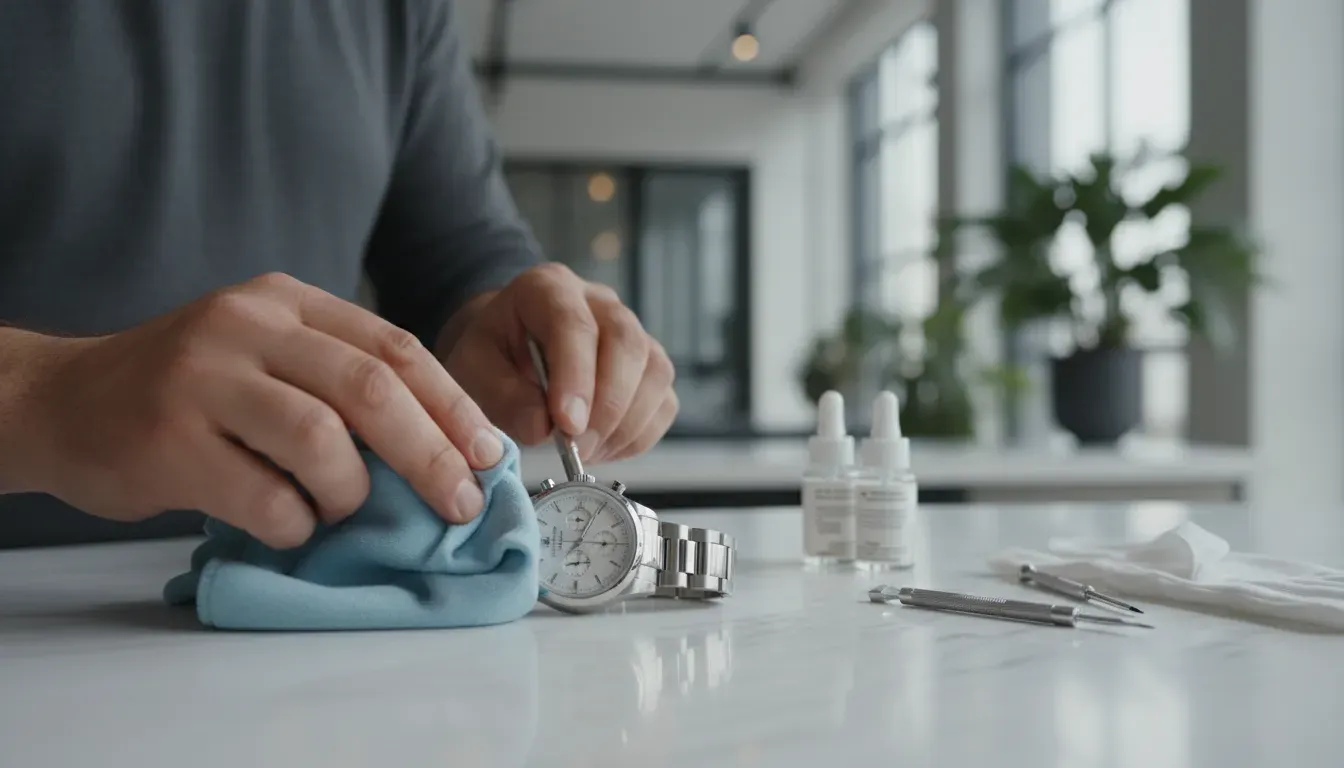
Clean your watch (assuming it is water-resistant) periodically with a soft toothbrush and mild soapy water. Get in the crevices between the lugs and the bracelet links where “wrist cheese”—a gross mixture of dead skin, sweat, and dirt—accumulates. This grit acts like an abrasive, stretching out your bracelet links over time (known as “bracelet stretch”).
For polishing, be careful. Over-polishing softens the sharp edges of the case design. However, for a quick touch-up on high-polish stainless steel surfaces, Cape Cod Metal Polishing Cloths are the industry secret. Just keep them away from brushed surfaces, or you’ll turn your matte finish shiny.
Final Thoughts: The Long Game
Caring for a mechanical watch isn’t a chore; it’s a ritual. It forces you to slow down. Winding your watch in the morning is a moment of mindfulness, a physical connection to the time you are about to spend.
By adhering to service intervals, respecting the mechanism when winding, and storing it safely, you aren’t just maintaining a machine. You are preserving a story. A well-maintained mechanical watch is one of the few objects in our modern world that can genuinely outlive its owner. Treat it with respect, and it will keep time for your grandchildren.
For more insights on building your collection, check out our guide on luxury watch brands or learn how to switch up your style with our watch strap guide.