Understanding Watch Sizes: How to Find the Perfect Fit
Master the art of watch sizing. We break down lug-to-lug distance, case diameter, and wrist geometry to help you buy online with total confidence.

Understanding Watch Sizes: How to Find the Perfect Fit
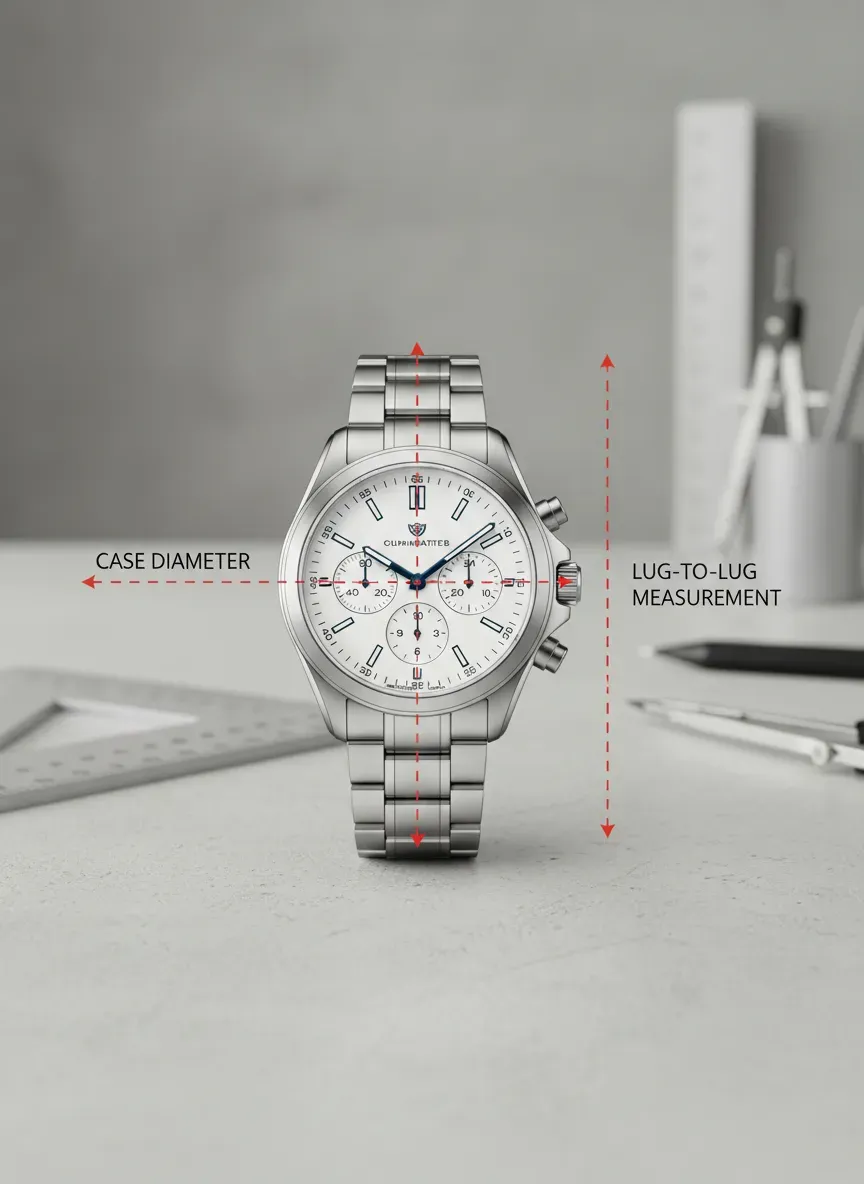
Finding the perfect watch fit comes down to three specific metrics: case diameter, lug-to-lug distance, and wrist circumference. As a general rule, your watch’s lugs should never extend beyond the width of your wrist. For a wrist circumference of 6 to 6.5 inches, target a case diameter of 34mm to 38mm with a lug-to-lug distance under 46mm. For wrists between 6.5 and 7.25 inches, the sweet spot is 38mm to 42mm with a lug-to-lug under 50mm. Those with wrists larger than 7.5 inches can comfortably wear 44mm+ cases. However, keep in mind that case shape, thickness, and integrated bracelets significantly alter how a timepiece wears on the wrist, meaning the “lug-to-lug” measurement is often more important than the diameter itself.
The Geometry of the Wrist: Beyond the Diameter
We have all been there. You see a high-res photo of a stunning diver or a sleek dress chronograph. The specs say “42mm.” You think, “I have a 42mm watch, this should be fine.” You click buy. It arrives. You put it on.
And it looks like you’ve strapped a dinner plate to your arm.
The problem isn’t your wrist; it’s the industry’s obsession with a single number: case diameter. While diameter gives you a rough idea of the “face” size, it tells you almost nothing about the “footprint” of the watch. To truly master the art of buying watches online—without the heartbreak of returns—you have to start thinking like an engineer and less like a catalog browser.
The “Lug-to-Lug” Revelation
If you take only one thing away from this guide, let it be this: Lug-to-lug distance is king.
This is the measurement from the very tip of the top lug to the tip of the bottom lug. It represents the vertical length of the watch across your wrist. You can have two watches that both measure 40mm in diameter. One might have short, curved lugs (like a Seiko Turtle), giving it a compact lug-to-lug of 47mm. The other might have long, straight lugs (like a Nomos Tangente), stretching the lug-to-lug to 50mm or more.
On a 6.5-inch wrist, the first watch will look tailor-made. The second will hang over the edges of your arm, creating an unsightly gap between the strap and your skin. This “overhang” is the cardinal sin of watch fitting. It makes the watch unstable, uncomfortable, and frankly, it looks like you’re wearing your dad’s watch.
Wrist Circumference vs. Wrist Surface Area
Let’s get tactile for a second. Grab a measuring tape. If you don’t have a soft tailor’s tape, use a strip of paper and mark the overlap point, then measure that against a ruler.
Knowing you have a “7-inch wrist” is step one. Step two is understanding your wrist’s topography.
Wrists generally fall into two categories: Round and Flat.
- Round wrists are fleshy and cylindrical. A 7-inch round wrist might effectively have less “flat surface area” on top for the watch to sit on.
- Flat wrists are wider and bonier. A 7-inch flat wrist can often support a larger watch because the top surface provides a broader landing pad.
If you have a round wrist, you want watches with lugs that curve downwards aggressively to hug the arm. If you have a flat wrist, you can get away with flatter case profiles.
For those just starting their journey, understanding this geometry is crucial before dropping money on high-end pieces. If you are looking for inspiration on where to start, check out our guide on the top 10 entry-level luxury watches, where we break down specific models that tend to fit a wide variety of wrist shapes.
The Thickness Factor
Height matters. A 40mm watch that is 10mm thick will slide under a dress cuff and hug the wrist. That same 40mm watch at 15mm thick will feel top-heavy and wobble. This is often determined by the movement inside (automatic chronographs are notoriously thick) and the water resistance rating.
Deep-sea divers need thick crystals and case backs to survive pressure. But ask yourself: are you diving to the bottom of the Marianas Trench, or just diving into a spreadsheet?
For a versatile fit that works nicely with different case thicknesses, the Seiko 5 Sports Automatic is often cited as a benchmark for dimensions that work on nearly everyone.
Technical Analysis: Do Certifications Matter for the Fit?
Now that we have covered the physical dimensions, we need to talk about the “technical fit.” This is about whether the watch fits your lifestyle and expectations. When you browse specs, you’ll see acronyms thrown around like confetti: COSC, METAS, ISO 6425.
Do these matter for an entry-level collector? Or is it just marketing fluff designed to inflate the price tag?
ISO 6425 vs. The “Desk Diver”
You see “Water Resistant 200m” on a dial. Then you see another watch that says “Diver’s 200m.” They sound the same. They are not.
The “Diver’s” designation usually refers to ISO 6425 certification. This is a brutal testing regime where every single watch (not just a sample) is tested to 125% of its rated depth, checked for condensation, magnetic resistance, and shock resistance.
Does this affect the size? Absolutely. Achieving ISO standards often requires thicker gaskets, a screw-down crown with substantial crown guards, and a thicker bezel for grip. This adds bulk. If you want a slim, elegant skin diver, an ISO-certified beast might feel like a tank on your wrist. Unless you are actively scuba diving, a standard 100m water-resistant watch without the ISO bulk is usually the better “fit” for daily wear.
COSC and METAS: The Accuracy Game
COSC (Contrôle Officiel Suisse des Chronomètres) certifies that a movement is accurate to -4/+6 seconds per day. METAS goes even further, testing the fully assembled watch for anti-magnetism and stricter accuracy.
Here is the reality for the new collector: High accuracy often requires high-tech materials and intricate regulation mechanisms. Historically, this meant larger movements. Today, brands like Longines and TAG Heuer are battling to put high-performance movements into wearable cases.
If you are torn between brands that offer different levels of certification in the mid-luxury tier, it’s worth reading our deep dive comparison: TAG Heuer vs Longines. It highlights how these two giants balance technical specs with wearable case dimensions.
The Quartz Reissue: A New “Must-Have” Luxury Entry Point
We are currently witnessing a massive shift in watch culture. For years, “oversized” was the trend. If it wasn’t 44mm, it wasn’t masculine. Thankfully, that era is dead. We are returning to classic proportions—34mm, 36mm, 38mm.
And strangely enough, the humble quartz movement is leading the charge.
The “Grab and Go” Fit
There is a specific subset of the modern gentleman who loves fashion but hates the fuss of mechanical watches. They don’t want to wind a mainspring. They don’t want to pay $500 for a service every five years. They want the look, the brand cachet, and the perfect fit.
Enter the Quartz Reissue.
The most prominent example of this is the Tissot PRX. When Tissot revived this late-70s design, they tapped into a goldmine. It features an integrated bracelet (which means the strap doesn’t detach in the traditional way), creating a seamless flow from case to clasp.
Here is the sizing trap, though: Integrated bracelets wear significantly larger than their specs suggest.
The 40mm Tissot PRX has a rigid first link that extends the effective lug-to-lug distance massively. On a 6.5-inch wrist, the 40mm PRX flares out and looks awkward. Recognizing this, Tissot released the 35mm version.
On paper, 35mm sounds “small” to a modern buyer used to Apple Watches and 42mm divers. In reality? The 35mm PRX is the perfect fit for the average wrist. It captures that authentic 1970s “luxury sports” vibe that costs $30,000 from brands like Audemars Piguet, but does it for a fraction of the price.
Why Quartz?
Why choose the quartz version over the automatic? Aside from the lower price point, quartz movements are thinner. The Tissot PRX Quartz sits flatter on the wrist than its automatic counterpart. It slides under a shirt cuff with zero resistance.
This resurgence has made “small” cool again. It signals that you are confident enough not to wear a giant anchor on your arm. It’s a nod to the era of classic Hollywood, where leading men wore 32mm and 34mm watches.
If you are looking for other brands that are killing it with heritage reissues and overlooked gems, take a look at our list of 7 underrated luxury brands. You might find a vintage-inspired piece that fits your wrist geometry better than the mainstream heavy hitters.
The Final Verdict on Fit
Buying a watch online is a game of numbers, but also a game of self-awareness.
- Measure your wrist. Don’t guess.
- Ignore the Case Diameter. Look for the Lug-to-Lug.
- Check the clasp. If the clasp is longer than the underside of your wrist, it will be uncomfortable.
- Embrace smaller sizes. If you are on the fence between a 38mm and a 42mm, go for the 38mm. In the long run, comfort and classic proportions always win over bulk.
The perfect fit isn’t about having the biggest watch in the room. It’s about having the watch that looks like it was made for you. Whether that’s a high-tech certified diver or a sleek 35mm quartz reissue, wear it with confidence.
For a final recommendation on a watch that bridges the gap between dress and sport sizing perfectly, consider the Hamilton Khaki Field Mechanical. Its long lugs make it wear larger than its 38mm size suggests, providing a masterclass in how dimensions interact on the wrist.